

Day-to-day
How We Stay Organized and Keep Things Moving
Your first day at VOUW
1. What to Bring
Computer: Bring your own computer for work.
Work Clothing: Wear comfortable and practical clothing. A t-shirt and normal pants that can get dusty or dirty are ideal. Heels and long nails aren’t recommended. For tasks like painting, we have work suits and steel-toed covers available.
Notebook/iPad: Bring a notebook or iPad if you prefer. We encourage communication through simple sketches.
2. Set up
Join our WhatsApp group: Join our team WhatsApp group for quick communication: https://chat.whatsapp.com/KinSe2JpMhp4DcAK6HPbVS
Join our to do list: Your to do list should not live in your head. That’s where task managers come in. We highly encourage using a to-do list for personal use. You can follow Rick Pastoor’s recommendations to find a system that works for you.
Share your personal info: Email your IBAN and account name for salary processing, along with your emergency contacts, any allergies, and any other important information we should be aware of, to admin@vouw.com.
Email: Use your own email account for internal communication. We’ll create a specific email account for you if you’ll be contacting suppliers or clients.
Software: While there’s no mandatory software to install before you start, we commonly use Google Drive, Illustrator, Photoshop, Figma, Framer, Squarespace, Fusion 360, Blender, Rhino, 1Password, Cura, Google Docs, Google Slides, Google Sheets, Google Meet, and WhatsApp for communication.
3. Learn about VOUW
On your first day, you’ll have time to get to know our studio. We’ll also start with a group meeting so you can meet everyone and address any questions.
Read the handbook: Get to know our history and how we work
Meeting the Team:
Justus Bruns: Co-founder focused on organization, business development, communication, and client management. Justus also oversees our sister company, Convince.
Mingus Vogel: Co-founder responsible for design, creating proposals, communication, and leading R&D efforts. Mingus divides his time between computer-based work and hands-on tasks in the workshop.
Simon Luitse: Director of Engineering, responsible for overseeing R&D, production, testing, and maintenance. Simon also manages the Poem Booth schedule.
Gervaise Coebergh: Founder of The Blue Room, Gervaise assists VOUW in business growth and development. She will be at the studio periodically.
Workspace Tour: Simon will give you a tour of the workspace, introducing you to all the machines. Reading through the handbook beforehand will help you become familiar with the tools—we want you to be comfortable using them.
4. Familiarise yourself with the tools and our work
Instruction videos: Watch the instruction videos on the workshop page. Make sure you have watched the tutorial of any tool in the studio before using them. For your first use, also always ask Simon or Mingus for assistance, or Justus if it’s computer-related.
Project Videos: Watching the repair videos below of our projects to get a better understanding of our work.
Weekly planning session
Time: Every Monday at 10:00 AM.
Place: We meet at the whiteboard
Purpose: We start the week with a planning session where we review last week, look at upcoming projects & goals and plan the week ahead using the shared To Do list.
Expectations: Everyone, including interns, is expected to be proactive. Don’t wait for tasks to be assigned—speak up and share your thoughts. We use a simple calendar overview that shows the next 10 weeks to stay organized and focused.
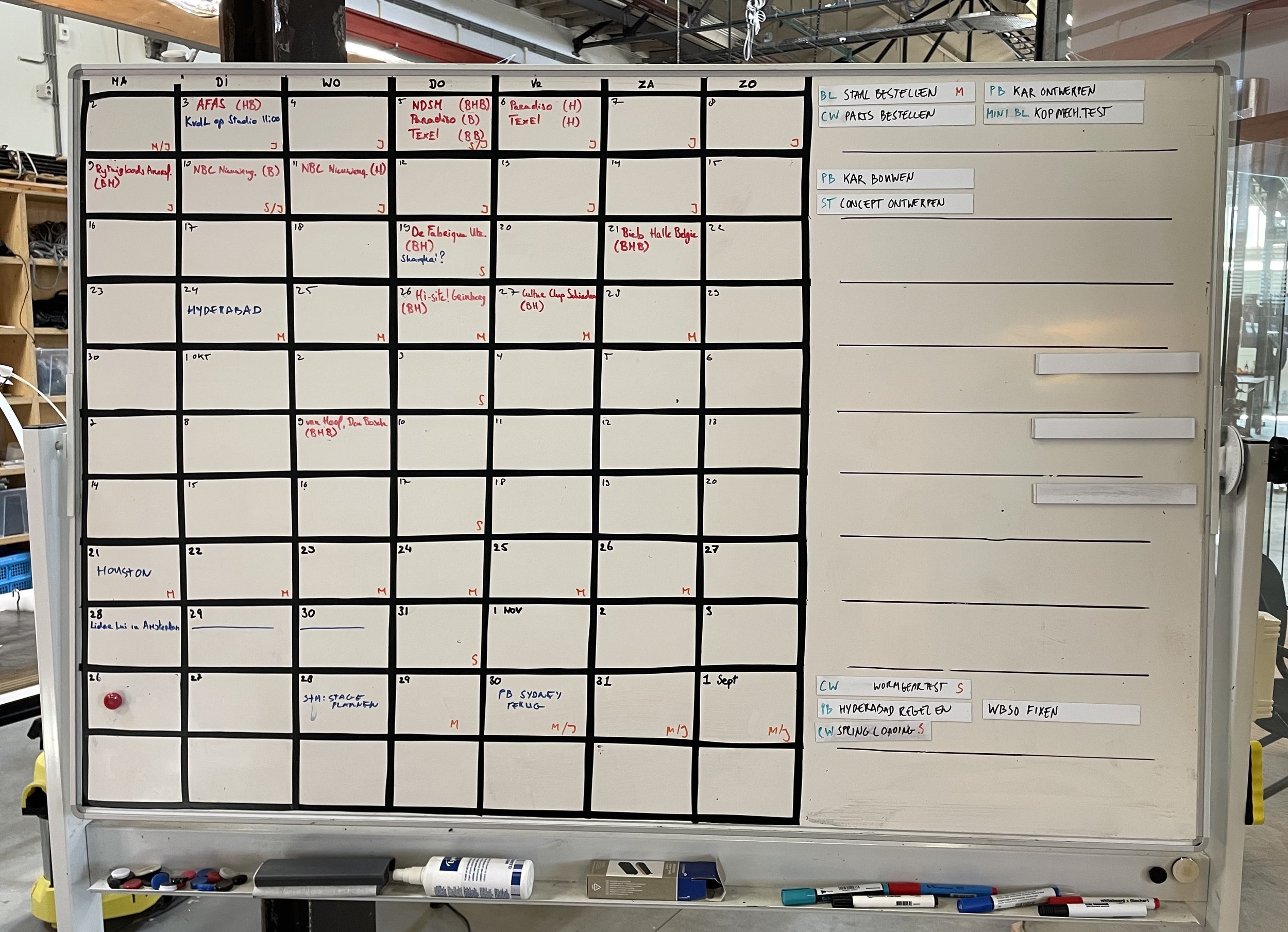
The Whiteboard Schedule
We use a whiteboard to keep track of the schedule and tasks:
In Red: Deadlines and reservations
In Blue: Appointments and planning
In Orange: People—absences are noted in the bottom right corner, while task assignments are indicated next to specific tasks
In Green: Projects
On the left side of the whiteboard is the calendar, displaying important dates and milestones. On the right side are the specific tasks we aim to complete during the week.
How to work
This might be the most important part of this handbook.
Because working hard is easy. Being a perfectionist is easy. Working productively, that’s the real challenge.
It’s not easy, but it is simple.
The Process
Whatever you’re doing, whether it’s designing a complex new project or sweeping the floor, use this loop:
Define the goal
List the requirements
Brainstorm solutions
Execute
Compare your result with the goal and requirements
If not good enough: repeat
This is based on the Delft Design Method. We live by it.
How to be a team member
Communicate clearly
Share your ideas and your solutions. Don’t just say what’s wrong, but propose what might work.
If you only drop problems, you're just handing off work to others. You're part of VOUW because you can think. Use that.
Take ownership
Think ahead. Don’t wait for tasks, but suggest what you can do.
“What should I do?” = giving someone else work.
Instead:
“I’ve got time. I was thinking of doing A or B. What do you think?”
Update often
Let us know what you're doing. Even the small stuff. Better too many updates than too few. Don’t make others chase you.
Be a fixer
Everyone loves fixers: people who take on the hard jobs at inconvenient times and don’t give up until it's solved.
Challenges are just steep parts of a learning curve. Doing them is how you grow, and how you build confidence.
Become a fixer, and you’ll be valued everywhere.
Remember
If you're new, especially as an intern, we don’t expect perfection.
You're here to learn. These habits will help you grow anywhere, not just here.
How You're Evaluated
We don’t use points or performance systems.
But if you want to grow here, or anywhere, these are the three things that matter:
Competence
Are you on time? Do you work hard? Do you finish what you start?Initiative & communication
Do you think ahead? Offer ideas? Speak up in meetings? Take action without being told?Quality of work
This might seem like the most important one. But if the first two are solid, this one usually follows.